Comments

3-comments

Pune Ganesh Visarjan 2015


It was a much awaited trip to be a part of the Ganesh Visarjan procession at Pune and finally I got a chance to experience it.  Ganesh Festival in Pune was started with Bal Gangadhar Tilak  with five mancha ganapati's. This was a platform for community gathering, and  sharing their pains and gains with neighbours.

We started from Mumbai at around  06:40 am by Intercity Express and reached Pune at around 10.30 am. We had break-fast at a local joint and headed to Laxmi Road, the place of all processions .

A huge welcome rangoli was drawn at the centre. 


There were five “Manache” Ganapati mandals – Kasba Ganapati mandal, Tambadi Jogeshwari mandal, Guruji Talim mandal, Tulshibaug mandal and Kesriwada Trust mandal.

We were on the road to witness the charisma of five Manache Ganpatis. All eyes were looking into one direction only.


We reached just-in-time to wave goodbye to the first Ganapati.


The traditional ways of Dhols and attires of Navarri Sarees and Kurtas made the processions more colorful .


As the tradition goes, each Moorti has a Dhol Pathak (Group of members playing Dhols) leading the procession.  Each of them have their own way of attire.

Pune’s Iconic Dhol Pathak (Drum troupes)

Everyone were jumping with joy and dancing to the tunes of the dhols. With each beat, energy levels were going up.


The streets were filled with thousands of participants enjoying the drum beats.


Each of the Pathak, with their royalty and grandeur ,took us back to the history of Shivaji's times.


The traditional way of  all the five  grand processions were electric. 


As  the dhol beats were rising, energy levels were up and everyone waited with their heads and hearts on the road for the next Pathak to enter.


Some wore costumes that carried a message, banners, hoardings, placards etc etc . Some chose to use the procession as a platform to promote their message.


When the sun was high and energy low, we headed back to a local joint in the afternoon hours. After taking rest for some time, we headed to the river next to the bridge where Ganesh idols are ideally immersed. Pune Municipal Corporation had made arrangements to  immerse Lord Ganesh idols in water tanks rather than going in for the usual river immersions. But some of them preferred  the immersion into the river only.


As the light of the day dimmed, the colorful lights on the Ganesh Pandals became brighter.  Each pathak had a theme.


The crowd got thicker and the sounds got louder with Bollywood music. 

After another few hours of dancing, it was time to leave. Finally we had enjoyed the most awaiting festival in Pune- Ganesh Visarjan 2015.  

Flower Trek to Tikona Fort


Tikona also known as Vitandgad,  is a dominant hill fort in Maval, in the Indian state of Maharashtra. To reach the place, head towards  Lonavala and then to Kamshet and then drive towards Gavhande village which is also called Tikona Peth.  Once you reach the village, there is a temple and vehicles can be parked near the temple. After a small introduction session, we started our walk towards the base of the fort.


A walk about 1.5 km will take you to the starting point of the fort. The trek starts from here. The 3500 feet high hill is pyramidal in shape and the name Tikona means "triangle".


Then the trek goes up and turns 180 degree towards the fort. Once you go up the initial slope and turn towards the fort, you are on an edge with valleys on either side.

While going up, the views of Pawna dam and the surrounding areas are absolutely mesmerising.


Some wildflowers were also seen on the way. Then we reached the main and most guarded entry to the  Fort.


After crossing the main entrance and a few minutes walk, we reached another entrance.


Then the trek goes through a vast area.


On the way we saw a temple of Lord Hanuman.


Cool weather and a walk through the woods was memorable. After a few minute walk we reached the temple named Lord Tuljadevi Mandir. There is small lake in front of the temple.


Soon we reached a 'V' shaped junction . A sign board was placed there to help visitors . We continued our climb  through the left side.


There is a massive stone wheel located within the fort. This big stone wheel was operated with the help of bulls.  From this point, the final ascent to the top begins.


The stairs are steep and each step is much bigger than a regular step. A rope with bolts is fixed which gives you support while climbing.


Guarded by watchtowers and water tanks, this entry is a small duct carved in stone with big steps and so is a tough path to climb.


At the end of  the steps, we saw a very beautiful bastion fortification and caves on the right side. This is also known as Bale-Killa.


After crossing this, we reached a vast area with compound wall all around.  We took a small break to capture the wonderful scenery around us.  Then we moved to the top of the fort. The final stretch was through steps with  hand railings.


There is a temple of  Tryambakeshwar on the top of the fort.

Once you reach the top of the plateau, the view is amazing. This fort has the highest number of water reservoirs which are still good and holds water even now.


Standing on the top, you get a spectacular 360 degree view of the surrounding area. From the top, you get an excellent view of Tung Fort, Pawna dam, Lohagad and Visapur forts. Orange Maratha Empire Flag with Chhatrapati Shivaji Maharaj riding on Horse stands tall on the top of the fort.

We had some snacks which we had carried with us and after some sight seeing we started our descend from the fort. On the way,  greenery, plants and flowers of different  kinds on either sides of the path inspired me to click.

Overall,  it's a nice one day trek which I would recommend , especially during  the monsoons . 

A few glimpses of Dahi Handi 2015, Mumbai

"Handi"
Dahi Handi or Govinda is a popular festival celebrated across India and the best place to see this 'sport'  is in Mumbai, Maharashtra, India. It celebrates the legend of Lord Krishna stealing butter as a child. The festival activity involves the making of a human pyramid that would be climbed by  participants who would be known as 'Govindas' . The aim of the activity is to climb to the top and break the pot filled with a mixture of milk, dry fruits, ghee . It is celebrated on the second day of Janmashtami.

Here are some pictures from the celebrations in Mumbai.

3.30 pm:  Govindas start arriving 


4.30: There are several teams for trials. Cash and gifts are offered for Govinda troops to participate.
Govindas forming a human pyramid to break the Dahi Handi, in Mumbai
Little Govinda

9:00 pm : Below is a sequence of photographs I managed to take, demonstrating the pyramid going up and the Handi finally being reached by little Govinda.


Chor Bazaar-Thieves Market


There are many stories about the name of this bazaar. One story is that if you have lost your belongings, you can find them in this bazaar - thus justifying the name - Chor Bazaar . But this bazaar is said to sell mostly second-hand goods rather than stolen goods.

It's located on Mutton Street, in the busy market area between S V Patel and Moulana Shaukat Ali Roads, near Mohammad Ali Road in south Mumbai.

This market is divided into two sections - Mini Market and Juma Market. The Mini Market is renowned for selling Bollywood posters while the other deals with hardware.

I walked through streets of Mini Market. It was lined with shops selling almost everything under sun. There is no better place for souvenir digging than this large flea market, especially if you are seeking antiques and vintage items.


Apart from antique items, you can also find ingenious reproductions and miscellaneous junk at the street. I stopped to look at the clocks, old gramophones and manual typewriter. You will find old fans, car parts, scores of shops selling spanners and screwdrivers hardware items.

Old Gramophones in Chor Bazaar

You can also spot almost all kind of sports goods- Cricket bats, balls, shuttle cocks and skipping ropes. If you have good bargaining skill, then this might be the place to be. Haggling and bargaining is the norm here.

I have never seen a collection of coins elsewhere.
Old coins for sale, likely all fake, in chaor bazaar

Other than the music systems and accessories, one can buy second hand phones, Chinese phones or even an Apple Iphone.

The area is full of crowded streets and crumbling buildings. Except Friday, you can visit the shops between 11 Am to 7.30 PM. Most of the lanes are crowded with vendors selling all sorts of antique goods at reasonable prices.

This area has become one of the most tourist attractions in the city and is also a photographer's delight.

Dhobi Ghat: Massive Open Air Laundry in Mumbai


You must have seen this place in movies or heard about this Dhobi Ghat. This 140-year-old dhobi ghat  is Mumbai’s biggest human-powered washing machine. This place was constructed by the Britishers to build a system of  getting their soldiers’ clothes washed.

The best view is from the bridge across the railway tracks near Mahalaxmi railway station. From the bridge, you will see rows of open air concrete wash tubs.

When we crossed the entrance, we were greeted by the alluring smell of detergent. Every day thousands of kgs of dirty clothes - delivered from hospitals, hotels, barbershops and households - come to the Dhobi Ghat and are beaten and scrubbed, hung out to dry, folded and returned to sender.

The washing takes place in rows of concrete tubs. After being rinsed, the clothes are hung to dry before each piece is ironed. The dry clothes were sent for pressed to crisp perfection.  Then the clothes are marked with a code.

Besides the old-fashioned method of washing, the Ghat is also equipped with automatic laundry machinery. But most of the washing is done by hand. Most of the workers spend their day knee-deep in the scummy water.


There are hundreds of dhobis and their families that work and live at the Mahalaxmi Dhobi Ghat. Here, children are born and live sorrounded by concrete wash tubs. It is considered that occupation in Dhoi Ghat is  passed down by generations.

A visit to Mumbai is incomplete without a stop at the Dhobi Ghat, especially for shutterbugs, this area gives a great photo opportunities of Mumbai’s Day-to-Day life.

Bhimashankar & Nagfani Trek


Surrounded by natural beauty, Bhimashankar temple is one of the 12 Jyotirlingas in India. Trek to Bhimashankar is known to be one of the best treks in the Sahyadri ranges and it has two routes to climb from Karjat Region, in the Indian state of Maharashtra.  The first one is Ganesh Ghat, a simple one & the second  ascends via Shidi Ghat (Ladder route).

We started our journey early in the morning to Neral by Karjat Slow Train ( 06:17 am ).  By about 7.40 am, we reached Neral station. Then we proceeded towards Khandas by local transport. Khandas village is around 25 kms away from Neral.

Post breakfast at the village,  we started our walk. There is a bridge around 2 km from Khandas, and the route going to the right from the bridge is the Ganesh Ghat route. The route going to the left of the bridge goes to the Ladder route.

After a small introductory session, we started ascending towards Bhimashankar by the Ladder route.  The ladder route is a little adventurous and steep walk.


To reach Bhimashankar, we have to climb three mountains.  Though Bhimashankar has religious importance, it is the place worth visiting for all nature lovers. Its beauty enhances in monsoon season. It was mesmerizing to see water plunging from atop  the mountain to the forests. Checkout the beauty, so awesome here.


After half an hour of walk, we reached near a river. It had already begun to drizzle. The rocks were slippery and we crossed the river by helping each other.


It was interesting to watch a dog chase us right from the bridge from where we started the walk and crossed the river with us.


After crossing the first mountain, we continued  our trek to the second mountain via Ladder route. The forest of Bhimashankar is a paradise for nature lovers as it hosts several exotic species of wildlife. 


Soon we reached near the ladder and I had to climb this steep and elevated path.  The ladder is divided into two but these two are joint in the middle.  When we climb the first one, there is already another one waiting.


I started my climb. My legs were shivering. But I managed to climb the second ladder with ease. We were on the edge of a huge valley at least 300 meters deep besides the mountain and below the ladder.


After crossing these two deadly ladders ,the path becomes more dangerous and alarming . This route is the shortest and the most adventurous trail to Bhimashankar and  it involves a bit of elementary rock climbing.


Water flowing beneath the rocks from the cracks makes it more slimy, soapy and unsafe.

  
There was a huge valley beside me.  We were walking through 80 degree angular vertical path full of slippery rocks. 


After crossing the steep rock path, we had to climb the third ladder which  is also dangerous and shaky but it is surrounded by rocks from both the sides .

After climbing the third ladder,  there was a huge climb and this time it was perpendicular 90 degree. The 90 degree path had crevices having a width of just 2 inches maximum and at least 30 – 50 meters straight up.   After that there was a sigh of relief as there was a waterfall nearby and a very good place to sit.


We rested at a small hut specially made for trekkers. They served local Maharashtrian food - bhakari with chutney.


Farming was done here near to this hut. The lush green fields and houses of Padarwadi village was a sight to behold.


Here our trek to the second mountain was over . Now the final mountain remained which was comparatively less dangerous and some what similar to the first mountain but the height was more than around 1000 meters . Trekking with greenery and fresh wind makes life easier here.


Then the trek goes through a narrow foot path. There was a deep valley on  the left side .  Though the trek is a test of your endurance, it is quite worth for the scenic view it offers. The long stretches of greenery, streams and waterfalls are simply mesmerizing to watch.


After about 5 hours of  trek from Khandas village, we reached Bhimashankar temple. Our stay was arranged in a guest house near to the temple. We kept all our baggage inside.

It was already evening and we started our second part of the trek i.e visit to Gupt Bhimashankar. It took 2-3 kms through the dense forests to reach Gupt Bhimashankar. The place is very sacred and is the actual place where the shiv lingas were originally discovered. The Bhima River which originates from the temple flows to this place. It said to be the origin of the River Bhima. The shiv linga is placed under a waterfall. It was nice to have a good natural massage under the falls. That recharged all of us.


Bhimashankar is a reserved forest area of 130.78 kms and  was declared a wildlife sanctuary in 1985.This sanctuary is a part of the Western Ghats, so it is rich in floral and faunal diversity. A variety of birds, animals, insects and  plants can be seen.

After spending some time under the waterfalls, we returned to the  temple. It was dark by then. We then visited the temple of Lord Shiva and witnessed the evening Aarti.

The temple of Bhimashankar is around 1200 – 1400 years old and is built on the Hemad Panthi style.
The shikhara of the temple was built by Nana Phadnavis. There are very beautiful sculptures and paintings on the roof and pillars of the temple. There is also a 15-20 feet high “Deepmala” or lamppost in the outer corridor of the temple.


A spiritual place located amidst nature, Bhimashankar makes for a perfect weekend getaway. On all sides are shops with people selling a whole range of items.

There are a lot of shops selling sweets on your way down to the temple which is located at the lower level of the hillside.

At approximately 9 pm, it was time for dinner.  All of us were tired but we managed to play Antakshari for sometime.

Day 2:

After breakfast, we started our  walk towards Hanuman Mandir, wherefrom the climb to Nagfani point starts. At the entrance of the temple there is a board indicating the direction to Nagfani. 


The walk to Hanuman Mandir was one of the best moments of the trek.  A 20 minute short climb from the Hanuman Mandir took us atop the highest point of Bhimashankar.

We finally reached the Nagfani peak . The tip of the mountain looks like a hood of cobra .Hence the name  is Nagfani (Nag = Snake i.e. Cobra; fani = Hood).

From the point one gets a panoramic view of Padar Killa down below, and the hills and forts of the Matheran range in the background. Walk uphill to the right of the point and one gets a fascinating view of the Bhimashankar temple area and Siddhagad fort in the background.

When we reached the place, the entire area was covered by fog. We were lucky that the clouds cleared up for just a moment to present us a beautiful view of  the surroundings.


 It was interesting to watch coins  on trees on our way back from Nagfani.


The climate was so cool, it felt so fresh. Then we started descending towards Khandas by Ganesh Khinda.  It was a beautiful walk and a memorable one too.

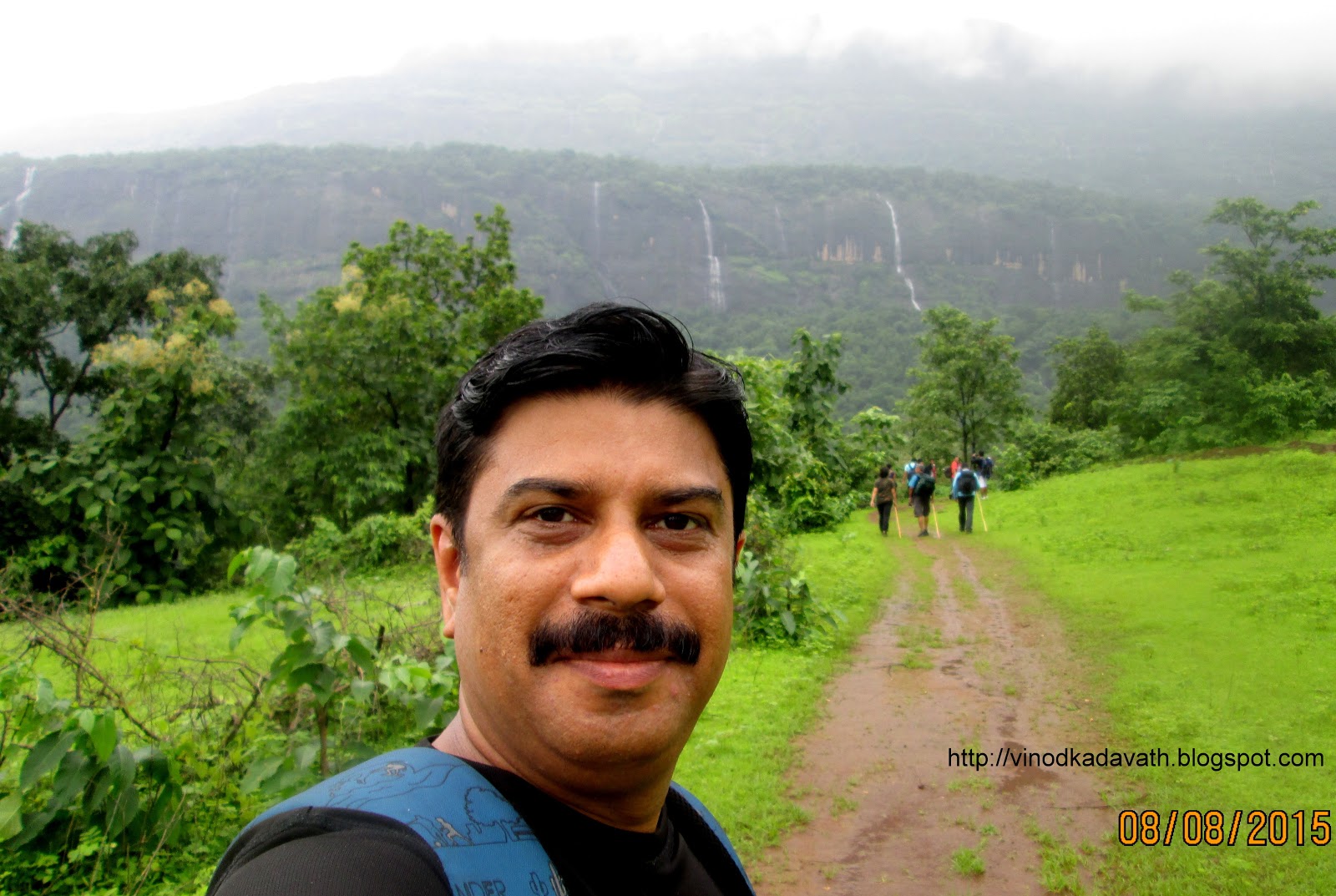
By around 4 pm, we reached the base and  we were on the plateau of Padargad, where we waited for the entire group to arrive.


Till then, we soaked in the final views of the beautiful mountain (which appears like Lord Shiva sitting in meditation) studded with waterfalls and mist all around.

Then we walked towards Khandas village where the private vehicle was waiting for us. After having lunch, we started our return journey to Karjat to catch the local train to Thane. Am sure that one can surely enjoy this adventurous trek especially in monsoon.