Sunday, December 28, 2014

Yacht sailing in Mumbai


There are some Sundays when you simply want to do something different.

One sunny Sunday evening in Mumbai, I was looking for a little adventure—something away from the usual city routine. That was when I came across an opportunity to go sailing. Without thinking too much, I booked myself a seat.

And that is how I found myself heading towards the Gateway of India, ready to experience my first sail on a J/24 Class sailboat.

Setting Sail from the Gateway of India

As per the itinerary, I reached the boarding point near the Gateway of India. The meeting point was at a small private jetty opposite the Taj Mahal Palace Hotel. 

Gateway of India

The scene itself was beautiful. Boats of different sizes were resting peacefully on the water, while the iconic Gateway and Mumbai's waterfront formed the perfect backdrop.


Our sailing boat was anchored a little away from the jetty. To reach it, we first boarded a small rowboat. A few minutes later, in the middle of the harbour, we transferred from the rowboat onto the actual sailboat.

That was when the adventure really began.

On Board the J/24

When we reached the sailboat, the captain was already busy preparing it for the sail. He welcomed us and explained a little about the boat and its importance.

Once everyone was on board, the helper began preparing and opening the sails.

As the sails caught the wind, the boat slowly came alive.

There is something incredibly special about travelling by sail. Unlike a motorboat, there is no constant roar of an engine. Instead, you hear the wind, the movement of the water and the occasional sounds of the boat itself.

It feels almost timeless.


Mumbai from the Arabian Sea

Soon, we were sailing away from the shore.

Sitting in the middle of the Arabian Sea and looking back at Mumbai's skyline was an unforgettable experience. The city that normally feels so crowded and energetic suddenly appeared calm and distant.
The wind was strong and refreshing. The sky was clear, and the setting sun gradually painted everything in warm shades of gold.

For a while, the noise and chaos of Mumbai seemed to disappear.

There was just the sea, the wind, the sailboat and that spectacular skyline.

Mind-blowing winds, a beautiful sunset and being away from the hustle and bustle of city life—that's why we love sailing.

view of Mumbai's skyline from the boat

A Different Way to Experience the Ocean

This trip also made me realise something I hadn't really thought about before.

Sailing isn't just about adventure. It offers a much more intimate and natural way of experiencing the ocean. With the wind powering the boat, you feel much more connected to the sea and your surroundings.

There is something wonderfully peaceful about simply letting the wind determine your direction.

And, of course, being out

Sailing Back Towards the Shore

After spending some time sailing, it was time to head back towards the shore.

As we approached Mumbai again, the city's famous landmarks gradually came into view.

I couldn't resist taking photographs.

The magnificent Taj Mahal Palace Hotel stood proudly beside the waterfront, while the Gateway of India appeared against the evening sky. Seeing these iconic Mumbai landmarks from the water offered a perspective that you simply don't get from land.

I kept clicking pictures as the boat moved closer to the shore, trying to capture the moment.

Taj Mahal Hotel 

A Sunday to Remember

Eventually, our sail came to an end.

My first sail on a J/24 gave me more than just photographs. It gave me a few peaceful hours away from the city, a beautiful sunset over the Arabian Sea and a completely new perspective of Mumbai.

Sunday, December 14, 2014

Sandhan Valley Trek


Sandhan Valley is a part of the beautiful Sahyadri mountain range, which is located in Nasik , in the Indian State of Maharashtra.

We started our journey from Mumbai on 12th December midnight to explore Sandhan Valley.  We all gathered at Kasara Station at around 1.30 am  and took a jeep to Samrad village. The 2 hour jeep journey uphill having narrow roads and curves, was not all comfortable. 

We reached Samrad village at around 4 am. The atmosphere was extremely cool . We rested in a temple complex nested by houses.  At the crack of dawn, we strolled around the place. The early morning was magical - village life, beautiful  sahyadri mountain ranges and sunrise. There was a primary school near the temple. I stood there for some time watching children coming to school and the children in turn were curiously watching us, in our trek dress.

Beautiful view of Sahyadri mountain ranges

After breakfast, we moved to Santhan valley. After 2 kms of walk, we reached the entrance of the valley. There were other large groups already on the trek. There were few rappelling patches in Santhan Valley trek and it would take more time for all trekkers to descend . So we changed our plan. We further planned to trek the Ratangad fort via Trimbak Darwaja. Three months back, I had gone for a trek to Ratangad fort via Ratanwadi.

Ratangad fort

We walked through the  forest, green valleys and  grass lands. We lost the way in between. Luckily, we met some villagers and they showed us the actual trek path. The group had already splitted into small groups.  After few hours, past beautiful terrains, we entered the fort via Trimbak Darwaja .

After exploring the fort, we started descending. We took rest under a tree, waiting for other groups to join  us.  We  reached  Samrad village by about 6:00 PM for night camping. The sun had just began to set. In the distance, the sky turned in a blaze of orange and red shade as the  sun set behind the hills.


We had a tiring day but we decided to make the rest of the day enjoyable. Before the night set in, we collected enough firewood from the surrounding area. We set a campfire, sat around it and had fun. 

Camp-Fire

We had to spend the night in the village houses.  We had our dinner and went to sleep so that we can get up early  next morning to begin our Sandhan Valley Trek. Few of us accomodated to one of the village house and rest of the team adjusted in the temple complex. I selected one bed in the house and drifted into sleep.

Day 2:

We bid farewell to the villagers and started our trek in the morning at around 8 am. After a few minutes walk from the village, we reached the entrance of the valley. The actual trek starts from here.

Entrance of Sandhan Valley

Sandhan valley is 15-20 feet wide route, which is carved by water flowing between two huge mountains.  Every year, hundreds of trekkers brave the tough route in the valley, trek through huge rock patches to cross Santhan valley that is 200ft deep and about 2 km long.

One of the interesting experience in this trek is that one can actually feel that he is in a valley of shadows and  as one looks upward, one can see the ray of sunlight falling through the darkness.  After crossing some big rocks, we found a small water pond . In Sandhan Valley trek, you have to cross 2-3 water ponds.  The water level changes according to season. Each one of us crossed the water pool with luggage stuck to their back . This made the trek more exciting.


After continuous trekking (for more than 3 hours), we reached the first rock patch in the valley. The height of the rock patch was 80ft and there was no option but to rappel down. This was my first rappelling and I completed the task with no hurdles.


When light rays fall on the valley walls from different  angles and intensities, they create some beautiful shades on the rocks and walls. I was surprised to see these unspoilt manifestation of nature.


Before others reach, we started our journey towards the 2nd patch .  The descending is not that simple as it appears.


Soon we passed  the 3rd patch with help of a log of wood.


After crossing the second water pool we  headed towards end of the valley. Soon we reached the exit point of the valley.


At the end of the valley,  taking rest becomes a must. The place is in a heavenly spot. There was a big water body and we enjoyed some time there.


The last and final challenge is the long walk through the end of the valley to Dehene village which marks the end of the trek. Dehen village is around 6 km away from here. The trail is along the side of a dry river bed.  Some of us were singing songs which made us feel refreshed.

Soon our track changed to narrow tar road. We sat on a small bridge for rest and had some photographs and fun time. The sun was about to set.  We got a spectacular view of the sun setting down behind the countryside hills, making the evening landscape look serene.


On reaching the Dehene village, we changed our dress and had tea and biscuits. Our jeep was waiting to take us to Asangaon station.

A memorable trek that can be cherished for long.


Sunday, December 07, 2014

MUMBAI ON MOONLIGHT RIDE


We have often heard people say that Mumbai never sleeps. The city has a completely different atmosphere after dark—its streets become quieter in some places, livelier in others, and its iconic landmarks take on a whole new character under the night sky.

I had always been curious to experience Mumbai at night, not from the window of a taxi or from the back seat of a car, but from the seat of a bicycle. So, when I got the opportunity to join a night cycling tour of South Mumbai, I was excited to discover the city from a completely different perspective.

The Night Begins in Colaba

It was around 10:30 p.m. when I took a taxi from CST Railway Station to Colaba. The streets were gradually winding down for the day. Shopkeepers were pulling down shutters, taxis were dropping off their last passengers, and the usual bustle of the evening was slowly giving way to the quieter rhythm of the night.

According to the itinerary, our meeting point was 'Mad Over Donuts' at Colaba Causeway, at around 11:30 p.m. I arrived quite early and waited on the footpath outside the shop.

Soon, a few of my fellow travellers arrived, followed by the tour coordinators and team members. We collected our bicycles and helmets, received a small kit containing snacks and a juice pack, and gathered for an orientation and introduction session.

And then, shortly after midnight, our journey began.

Cycling Through the Heart of South Mumbai

We cycled along the spectacular P. J. Ramchandani Marg, surrounded by some of South Mumbai's most impressive colonial-era buildings.

There was something magical about seeing these familiar landmarks at night. Without the crowds and traffic of the daytime, the architecture seemed even more dramatic.

As we rode past the magnificent Taj Mahal Palace Hotel and the Gateway of India, I began to understand that this ride was going to be about much more than sightseeing.

Our first stop was the Asiatic Society Library.

A Pause at the Asiatic Society

We parked our bicycles and sat on the famous steps of the Asiatic Society. The steps are familiar to many movie buffs, having appeared in numerous films and photographs.

Sitting there in the quiet of the night, surrounded by historic buildings, was a wonderful experience. It was hard to believe that just a few hours earlier, these streets had been filled with the energy of Mumbai's evening crowds.

From here, we continued towards Horniman Circle.

Pit stop at The Asiatic Society Library

The Banyan Tree and the Story of the Bombay Stock Exchange

At Horniman Circle, our tour coordinator, Ishita, introduced us to a fascinating piece of Mumbai's history.

She showed us a banyan tree associated with the early history of India's stock market. According to the story shared during the tour, Indian cotton merchants used to meet under the tree in the 1850s to conduct their daily trades. One day, 22 of them reportedly contributed one rupee each and formed what became the Native Share and Stock Brokers' Association, which eventually developed into the Bombay Stock Exchange.

The modern BSE building stands only a short distance away.

It was fascinating to stand there at night and imagine the same area more than 150 years ago, when merchants gathered beneath a tree to conduct business that would eventually become part of India's financial history.

Bademiya and the Streets of Mumbai

We then passed the Horniman Circle branch of Bademiya, the famous Mumbai food establishment. By this time, it was closed.

Bademiya's story goes back to a much smaller roadside food stall in Colaba. I had visited the place a few months earlier and remembered the familiar scene of people stopping by for kebabs, with taxis and two-wheelers parked nearby.

Seeing it again during our midnight cycling tour was strangely different.

By now, I was beginning to realize that this ride wasn't really about ticking famous attractions off a sightseeing list.

It was about experiencing Mumbai at night.

From Rajabai Clock Tower to CST

Our bicycles carried us past some of South Mumbai's most iconic landmarks—the Rajabai Clock Tower, Bombay High Court, Flora Fountain and CST.

At every stop, Ishita shared stories and historical details about the places we were passing.

The information made the ride much more meaningful. Instead of simply looking at buildings, we began to understand the history behind them.

At one point, we found ourselves cycling through a darker alley where beggars, street children and late-night pedestrians formed part of the city's natural landscape.

Mumbai at night wasn't just about its illuminated monuments.

It was also about the people who continued to live, work and move through the city while most of us were asleep.

A pit-stop near Flora Fountain

CST Station at Midnight

We eventually reached Chhatrapati Shivaji Maharaj Terminus (CST).

CST is magnificent at any time of day, but there was something particularly beautiful about seeing its architecture at night. The lighting brought out the intricate details of the historic structure.

I stopped for a while to admire the building and take in the atmosphere.
                     
CST Station

Across from CST stood another magnificent landmark—the BMC building.

Lit up against the dark sky, it looked absolutely spectacular.

BMC Building

The Queen's Necklace

The next part of the journey took us towards Marine Drive.

As we crossed the Marine Lines flyover, we were rewarded with a stunning view of the Queen's Necklace.

The sweeping curve of Marine Drive, illuminated by countless streetlights, looked almost like a necklace laid out along the Arabian Sea.

This is one of the places where Mumbai's reputation as a city that never sleeps becomes particularly evident.

As the heat of the day disappears, people begin to come out. Teenagers, couples, families, joggers and groups of friends gather along the promenade to enjoy the cool sea breeze.

We had a long halt at Marine Drive.

Once we settled on the sidewalks, everyone became busy with the snacks and juice from our kits. We chatted, laughed and simply enjoyed the atmosphere.

For a while, I forgot that I was in the middle of one of India's busiest cities.

The sound of the sea, the cool breeze and the lights of Mumbai stretching into the distance created a feeling of being transported into another world.

Marine Drive

The Climb at Peddar Road

After the relaxing break at Marine Drive came one of the more challenging sections of the ride—the slope at Peddar Road.

After several hours on a bicycle, the climb certainly made us work for it!

Along the way, we also got a distant view of Antilia, one of Mumbai's most recognizable landmarks.

But there was little time to stop because our final destination was waiting.

Haji Ali at the End of the Night

We eventually reached our last stop—Haji Ali Dargah.

Located on a small islet in the Arabian Sea, the famous shrine is connected to the mainland by a narrow causeway that becomes accessible depending on the tides.

By the time we reached Haji Ali, the night was beginning to feel very different from when we had started in Colaba.

We had spent nearly five hours cycling through the city, stopping at historic landmarks, listening to stories, eating snacks, chatting with fellow travellers and watching Mumbai transform through the night.

Mumbai After Midnight

The frequent stops were actually one of the best parts of the tour. They gave us enough time to appreciate each place rather than simply cycling past it.

More importantly, the stories shared by Ishita made the experience much richer. Every building, street and landmark seemed to have a story behind it.

What I initially imagined would be a sightseeing trip turned out to be something much more personal.

I experienced Mumbai when the daytime crowds had disappeared, when some shops had closed their shutters and when most cities would have been fast asleep.

Yet Mumbai was still awake.

People were still eating, chatting, walking, working and enjoying the cool night air. The streets had their own rhythm, and the city's historic buildings looked almost magical under the lights.

Cycling through Mumbai before dawn gave me the chance to see a side of the city that I had never experienced before.

And perhaps that is the real charm of a night cycling tour—not simply seeing the sights, but feeling the pulse of a city while the rest of the world is asleep.

For me, this was one of the most memorable—and certainly one of the best—night-time experiences I have ever had in Mumbai.
Sunday, November 23, 2014

Heritage walk in South Mumbai


South Bombay is of course, my favorite part of town with the beautiful buildings and colorful activities on the street. A Facebook post is all it took me to call Nikhil and shown my interest to join with him for South Mumbai Heritage walk. The focus of the walk was to see the architecture of Neogothic, Mughal-influenced, Neocolonial, and Art Deco buildings built during the colonial period.

According to the tour itinerary, our meeting point was at CST station.  When all the team members arrived, we moved to Kyani & co restaurant which is one of the oldest Irani cafe in South Mumbai. The physical appearance of the restuarant still keep the old Bombay vibes. There was a huge rush even in the early morning. We ordered bun masks, Kheema pav, egg bhurji, cakes pastries and Irani Chai. I enjoyed vitage ad posters and aromatic smell of the restuarant.

After a fabulous Iranian breakfast, we started our walk. Since it was a Sunday,   wide roads turn into vanues for gully cricket and you can lazily amble through the streets, camera in hand. 


Victoria Terminus was built by the British, to commemorate Victoria Jubilee Day in 1887 when India's first steam engine puffed out to neighboring Thane. Built in Gothic architecture with carved stone friezes,  stained glass windows and flying buttresses, it is one of the finest architectural wonders in Mumbai. The dome is an octagonal ribbed structure with a colossal female figure symbolizing Progress,  holding a torch pointing upwards in her right hand and a spoked wheel in her left.

Chhatrapati Shivaji Terminus (Victoria Terminus)-UNESCO World Heritage Site


Municipal Corporation Building, Mumbai


Azad Maidan offers a great place for people in different age groups to play various games - cricket, hockey, football etc.  
 .
Azad Maidan, South Mumbai

Bombay Gymkhana is one of the premiere gymkhanas in Mumbai. The Gymkhana Grounds lie in the southern end of the Azad Maidan.
Bombay Gymkhana, South Mumbai

Located opposite to Bombay Gymkhana, fashion street is famous for the latest and the trendiest cloths. With over a varied array of 150 shops, Fashion Street is famous for it best bargain sale of ready made clothes and artificial fashion jewellery. Bargaining and bargaining hard is the name of the game here. One can easily spend a couple of hours here navigating through the dozens of street stalls.

Fashion street 

Flora Fountain at Martyr's Square is a  beautiful fountain with magnificent architecture and sculpture and is surrounded by business centers and heritage buildings . Constructed by the Agri –Horticultural Society of Western India in 1864, out of a donation by Cursetjee Fardoonjee Parekh, the iconic fountain has been carved out of white Portland stone. 
  
Flora Fountain at Martyr's Square  or Hutatma Chowk


Statue of  "Martyr with a Flame" at Martyr's Square  or Hutatma Chowk


There is a small ground near to the Flora Fountain which serve as gathering hubs for locals and tourists alike.  Looking around, one can see a series of interesting events. The area is lined with painters and artists busy drawing portraits or creating caricatures.

Near to Flora Fountain is second hand book stalls, that lines the nearby pavements, boast of a collection of decades old original copies, some new pirated books ranging from literature to science fiction to best-sellers.

Outdoor book market stalls


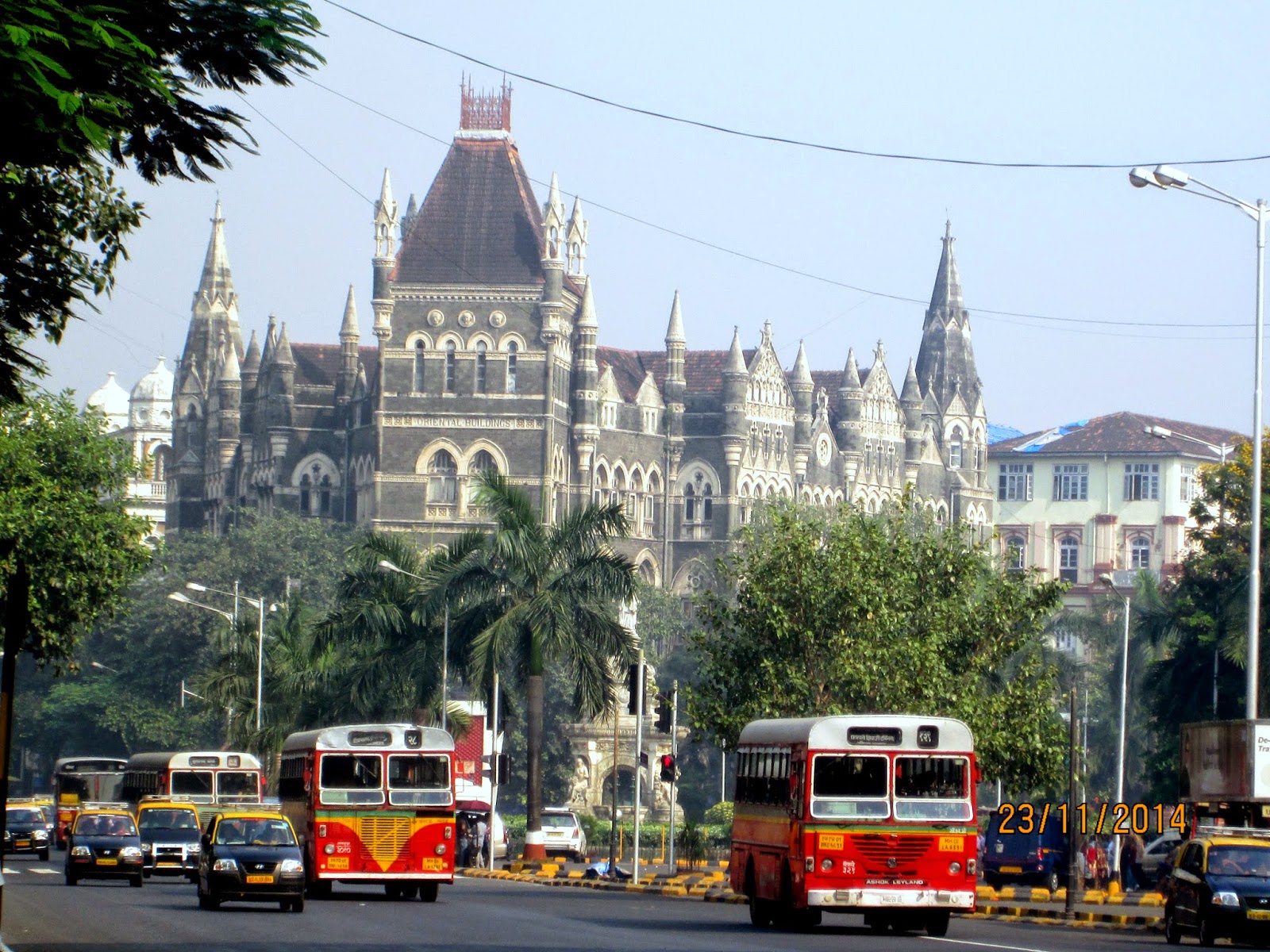
Oriental Buildings

East of oval maidan is the Big Ben like Rajabai Clock Tower riding from the Mumbai Universty Library.  

Rajabhai clock tower 

The Rajabai tower was designed by Sir George Gilbert Scott, an English architect. There is an interesting story about this tower. The entire cost of the tower was defrayed by Premchand Roychand, a prosperous broker who founded the Bombay Stock Exchange on the condition that the tower be named after his mother Rajabai. Premchand Roychand's mother was blind and as a staunch follower of Jain religion and was supposed to consume her dinner before evening. The evening bell of the tower helped her to know the time without anyone's help.

Buit in 1874, Bombay Universty looks very much like one of the older British universities. To the left of the university is Bombay High Court.

Central Telegraph office

There are many places to visit around Kala Ghoda. Kala Ghoda is a creative arena which housing Jehangir Art Gallery to the National Gallery of Modern Art. The area hosts an Annual Kala Ghoda Arts Festival where you can spot the installations of trending artworks.

It is said that, in 1847,  a group of young mechanics and foremen of the Royal Mint and Government Dockyard established a museum and library for mechanical models and architectural design. Sir David Sassoon,  contributed majorly for the cause and was completed in 1870. It is built in yellow Malad stone and above the entrance portico is a white stone bust of David Sassoon.

DavidSassoon Library

The Elphinstone College building is an architectural composition  of stone turrets with tiled pyramid-shaped roofs,  stone balconies and balustrades.

Elphinstone College
The erstwhile Watson’s Hotel, now called Esplanade Mansion, the 150-year-old structure, was Mumbai’s introduction to luxury hotels  and is in ruins now.   It is said that, when Watson’s Hotel first made the transition into Esplanade Mansion, its earliest tenants were advocates who opted the easy commute to their daily workplace.

John Watson, an English businessman, presented first luxury hotel in Mumbai. It hosted travellers like the British explorer Sir Richard Francis Burton, Hawaii’s King Kalakaua, Muhammed Ali Jinnah. After Watson’s death, the hotel passed through many hands, until it finally closed in the 1960s. Further the building was divided into smaller sections, which were rented out as residences and office spaces.
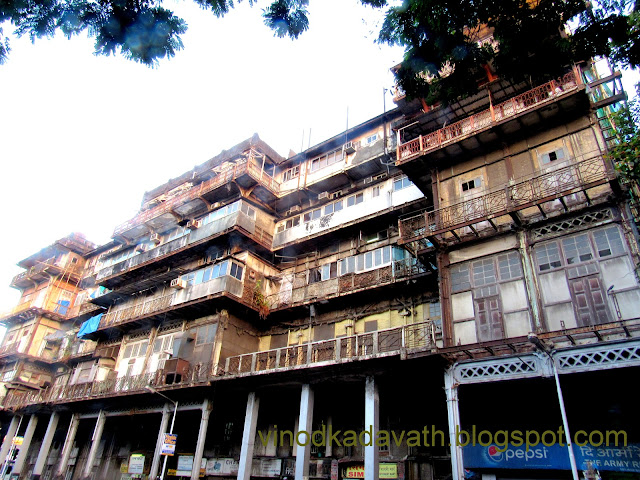
Esplanade Mansion


Bombay Stock Exchange

Opened in the year 1718, the St. Thomas Cathedral Church is the first Anglican church in Mumbai.  This is the huge church in the street. There were few people inside, so we just stepped inside.

 St.Thomas Cathedral


Horniman Circle

Next to Horniman Circle is the building that you may saw in Bollywood songs.  Asiatic Society Library is one of the most well-maintained and popular libraries in the country.

The Asiatic Society Library    


The walk ended at Colaba street market or Colaba Causeway, which is the iconic street for shopping and foodies.  The end of the street is the Gateway of India  and the Taj Mahal Hotel.

Gateway of India was constructed along the Mumbai Harbour in 1924.  Located at the tip of Apollo Bunder, this massive structure was constructed in honour of King George V and his wife Queen Mary when they were on their tour to India.  Constructed with a mixture of indissoluble concrete and yellow basalt, Gateway of India portrays Indo-Saracenic architectural style. The central dome of this magnificent structure measures around 48 feet in diameter. It has got 4 turrets explicitly carved with intricate latticework.

Gateway of India


Taj Hotels and Gateway of India

Popularly referred to as the Queen’s Necklace, Marine Drive is a 4 km long promenade and is one of the most beautiful roads in Mumbai.  

Marine Drive

The place comes alive in the evenings when people relax and admire the brilliant view or take a walk on the promenade overlooking the Arabian Sea. Chai-wallas, chat-wallas are common sight in this place.

Sunday, November 16, 2014

Backyard birding at Uran and Bhandup Pumping Station,Mumbai

  
This was my first bird watching trip in Mumbai.  Even though I am not so much enthusiastic for bird watching, I didn't want to miss an opportunity to do something different from my regular travel.

Wetlands form an integral part of the ecosystem of Mumbai city. Surrounded by the sea on three sides, these amazing patches of marshy land are home to a wide variety of biodiversity.

One fine Sunday morning, our group gathered at Vashi. The plan was to bird on Uran area. We headed towards Uran,  there we managed to see quite a number of wetland birds.  We walked towards the creek which has big water reservoir on one side and  other side filled with trees and mangroves.

Lesser Flamingoes, Greater Flamingoes, Cormorants, white cheeked Bulbul, Pied starlings, Pond heron, Egrets, Painted stork, Dove, Kingfisher and Blacked winged Stilts are some of the birds we spotted from this area.


It took us few hours to explore the whole area. By the time we were ready to leave, I found that it a paradise for local and migratory birds. We halted for breakfast on the way to Panje village, Jasai grasslands and other marshy areas in the vicinity. Although our guide explained to us the name of the birds, it is difficult to remember all those names.

Finally as we reached the Bhandup Pumping Station area, which is again a huge wetland, we saw a number of wetland birds.  This is the place where the sewage from the city ends up, and finds its way into the waste water management system.

This is one of the popular among birders not just for its wetland birds but also for scrubland species and raptors that are often sighted here. We made our way through tar road, stopping every now and then to click with our cameras at the variety of birds.

Sightings included  Black Winged stilts, Black eared kite, Kite, Booted eagle, Marsh Harrier, Green bee eater, Painted Stork, Spoon bills, Black head IBIS, Glossy Ibis, Brown headed Gulls, Common terns, River terns, Little Egret, Greater Egret, Common sandpiper, Garganey, Shrike, Ashy Prinia, Plain Prinia, Rock pigeon, Barn swallow and Alpine swift.

We could manage some good shots of butterflies as well.


Soon we returned to Vashi and bid goodbye each other. I hope that this lovely piece of grasslands remains intact and throws more surprise at us in the years to come.

A day well spent!