.jpg)
Visiting Chola temples had been on my mind for a very long time. Finally, the day came, I could make this Chola trail covering the temples at Thanjavur, Chola Puram, Chidambaram, Kumbakonam, Darasuram and Srirangam, during August 11-14.
Day 1 (August 11)
We started our journey at around 4 am from Kochi. The journey continued via Kottayam Kumily road. While passing through the high range road, we all were awestruck to see the glorious sight of mist at the backdrop of the mountains.

We had a pitstop at Peruvanthanam at around 8.30 am for breakfast. The views of the surrounding areas were absolutely mesmerizing.

After crossing Kumili ghat road, we had a short break around at 10.30 am at Cumbam Grape farm. There is a shop nearby from where you can purchase original grape wine that is brewed at the vineyard itself, at a cost of Rs.100/ per glass. They were also selling fresh grapes. Had few photo- session and it was a big relief to stroll under this sea of violet grapes especially after you have travelled by bus for a long time.
.jpg) |
| Grape farms at Cumbum |
Had lunch on the way at around 1 pm. It was already 5.30 pm, when we reached Thanjavur. So, we decided to visit the big temple, also known as Brihadeeswarar Temple. The Rain God welcomed us when we entered the temple.
This temple was built by the great Chola King Rajaraja Chola 1 and is dedicated to Lord Shiva and has one of the largest Shiva lingams in India. This temple is a part of the UNESCO World Heritage Site known as the "Great Living Chola Temples", along with the Chola-era Gangai Konda Chola Puram temple and Airavatesvara temple.

The temple is surrounded by fortified walls dotted with spaces to mount cannons and a big dry moat around it. The main gateways are on the east side. The temple complex has 3 entrance gates. The first being a small and simple gate called Maratha gate, built by the Marathas at a later period.
e |
| Entry is through a small Maratha gate, built at much later period by the Marathas. |
The Second one is the first Chola gopura and is called the Keralantakan tiruvasal, which means the "sacred gate of the Keralantakan".
 |
| The first Chola gateway/gopura known as Keralantakan tiruvasal |
About 100 meters (330 ft) ahead is the second Chola gopura known as Rajarajan tiruvasal. The inner eastern gopuram leads to a vast courtyard.
 |
| Second Chola gopura known as Rajarajan tiruvasal with its two large dwarapalas on either side of the door. |
The complete structure of the temple is made out of granite. The main Vimana (Shikhara) is a massive 16 Storeys tower of which 13 are tapering squares. The temple faces east, and a flight of stairs lead to a pillared mandapa.
One of the main attractions of the temple is a big statue of Nandi and is sculpted out of a single rock and is facing the main shrine.

The Nandi mandapa shows colorful paintings on its ceilings.
 |
| Nandi shrine |
The temple complex integrates a large pillared and covered veranda (prakara) in its spacious courtyard.
 |
| The pillared cloister that runs all-round the courtyard |
 |
| 108 Shiva-lingams inside the cloister |
 |
| Brihadeeswara Temple Gopuram at night |
It was already 8 pm, when we came out of temple premises and then moved to the hotel for a well-deserved dinner and sleep.
Day 2 (August 12)
Early morning, we visited the big temple again at 5.30 am. We waited for some time at the entrance for the gates to open at 6 am. We circled around the main structure and then entered the Sanctum Sanctorum. As the sun rises, the rays of it fall on the monument and it looks magnificent.
 |
| Brihadeeshwara Temple – view at sunrise |
Adjacent to Big Temple is Raja Raja Cholan Statue Park.
.jpg) |
| Raja Raja Cholan Statue Park |
After breakfast at around 7.30, we checked out from the hotel and proceeded to Gangai Konda Chola Puram.
Reached the place at around 10 am and visited the Gangai Konda Chola Puram temple. We were lucky to visit the place that day, which celebrated the 1053rd birth anniversary of King Rajendra Chola and his 1009-year-old capital. There were various cultural programs arranged in connection with the celebration.
Legend says that the Chola king Rajendra I, the son of the famous Chola king Rajaraja I, to commemorate his victory over the Pala Dynasty, founded the city. The name means the town of the chola who brought Ganga (water from Ganga) or who defeated (the kings near) Ganga.
 |
| Gangai Konda Chola Puram Temple Entrance |
The Nandi built in limestone is 200 meters away from the sanctum, facing the main shrine.

The well in the temple premises is considered a sacred place and water from this was used for all the activities at the temple. The interesting aspect is entrance to the well is through a Lion sculpture which is close to the well. A flight of steps takes one to the bottom of the well. This excellent structure is called as Simhakeni(Lion-well).
 |
| Simhakeni(Lion-well), Gangai Konda Chola Puram temple |
The temple has many intricate sculptures and carvings that depict scenes from Hindu mythology and legends.
 |
| From Left to Right: Kalantakan form of Lord Siva, Natarajan with smile, Lord Shiva garlanding a devotee (middle one) also kown as Sandeshanugrahamurthy, Vishnu with his two Wive's, Siva pleasing Parvathi. |
Originally, a two-storied hall ran all along the perimeter. None of it remains now, except for a bit that has survived on the northern edge of the complex. It is said that during the British era, stones from this part were carried away to build dam across the Cauvery River.

After darshan, we headed towards Chidambaram. We had our lunch at A2B restaurant at Chidambaram. It was around 2 pm when we finished lunch and temple will be opened at 4 pm only. For another 2 hrs., we had shopping around the temple area.
In Thillai Nataraja temple, Shiva is being worshiped as Nataraja, Lord of dance. The roof of the main sanctorum is covered by gold leaf. Another deity is Govindaraja, the form of Maha Vishnu as the Judge of the dance.
 |
| Chidambara Thillai Nataraja Temple |
 |
| Religious paintings on the walls & ceilings of Nataraja Temple, Chidambaram |
 |
| Shiva Ganga sacred pool |
It has entrance gateways on all four sides. From one point, you can see three gopuras at a time.

By evening we started to Kumbakonam. Checked in the hotel at night around 8.30 pm and had dinner.
Day 3 (August 13)
We started the day with Adi Kumbeswarar Temple, Kumbakonam at around 5.30 am. Adi Kumbeswarar temple is a famous Hindu temple dedicated to God Shiva located at the center of the Kumbakonam town.
The temple is approached by a long corridor with beautiful painting on the ceilings. The temple complex houses four Gopurams.
 |
| Adi Kumbeswarar Temple, Kumbakonam |
The temple was not opened when we reached the place, so we waited there for a while.
 |
| Adi Kumbeswarar Temple, Kumbakonam |
There are five silver-plated chariots in the temple which are used to carry the temple deities during festive occasions.
 |
| Adi Kumbeswarar Temple, Kumbakonam |
After darshan, we walked to the nearby Sarangapani temple.
 |
| Rajagopuram of the temple |
The temple is dedicated to Lord Vishnu. The procedure is to visit Lakshmi and then the lord Sarangapani. One of the interesting facts I noticed was, a cow is the first to have darshan of the Goddess and God, and only after that, devotees are allowed darshan.
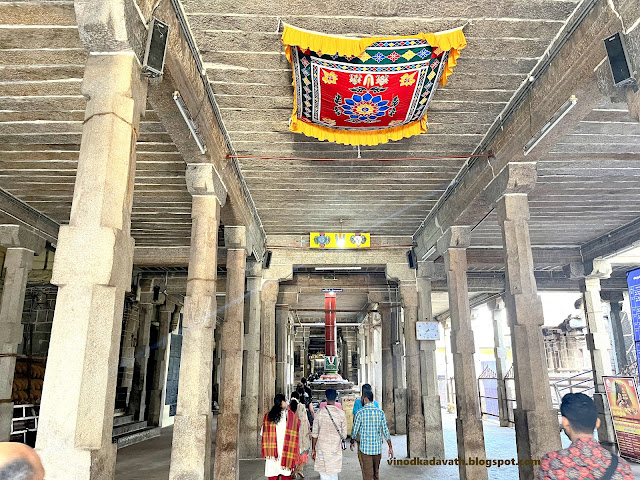
The main shrine is designed as a Chariot, in stone, with elephants pulling it.
Completed the darshan and return to hotel at around 8.30am. Post breakfast checked out and moved to Dharasuram, Kumbakonam.
Rajaraja Chola II built the current complex of Airavatesvara Temple in 12th century CE.
There is an interesting story about the temple. Sage Durvasa had cursed Indra’s elephant Airavata to lose its color and beauty for disrespecting him. Upset with guilt and regret, Airavat prayed to Lord Shiva at this temple location. Lord asked him to take a dip in the temple tank. This dip in the temple tank magically restored the color of its skin. After this incident Shiva Lingam at Darasuram bears its present name – Airavatesvara.
 |
| Airavateswara temple Main Entrance View |
One of the unique things is the musical steps at the entrance of the temple. These stone steps 7 different sounds on tapping. One can hear all the 7 swaras at different points. Now it is concealed with metal frames.
 |
| Musical Steps and Nandi at the temple |
The main temple complex is chariot fashioned. Whole complex is donned with carvings and sculptures of many Vedic and Puranic deities like Indra, Agni, Varuna, Vayu, Brahma, Surya, Vishnu, Saptamtrikas, Durga, Saraswati and many more.
 |
| Airavateswara temple Inner Temple View |
 |
| Airavateswara temple 108 Pillars Mandap |
 |
| Marriage of Lord Siva, Ardhanareeshwarar, a form of Shiva as half man and half woman(middle), Standing delivery,Shiva flanked by Brahma (left) and Vishnu |
We headed then to the town of Thanjavur for lunch. After lunch we proceeded to Srirangam. It was around 5.30 pm when we reached Ranganathaswamy Temple, Srirangam
Sri Ranganathaswamy Temple is a Hindu temple dedicated to Ranganatha (a form of Vishnu). The outer two prakarams (outer courtyard) are residential and markets with shops, restaurants and flower stalls. A 13-storey gopura (the Rajagopuram) - the main gopura on the street leads to the temple.
 |
Rajagopuram of Srirangam Ranganathaswamy Temple.
|
 |
| A 4-storey gopura |
 |
| A 5-storey gopuram |
To avoid the queue, we took a special darshan ticket of Rs 100 from temple complex counter.

The main shrine for Ranganatha is in the innermost courtyard. Shaped like Omkara (ॐ or Om symbol), the gold-plated Vimana ofSrirangam Temple is a sight to behold.
 |
| The Golden Vimanam of the temple |
It was already dusk. We had group photo in the backdrop of 1000 pillar mandapam. This massive theatre is worth a visit for its architectural splendor.
 |
| Thousand pillar mandapam is a theatre like structure made from granite. |
Near to the 100 pillar mandapam is a 9-storey gopura, commonly known as Vellai Gopuram (white tower) on the east side of the fourth enclosure has a steep pyramidal superstructure that reaches a height of almost 44 meters.
 |
| The Vellai gopuram (white tower) |
It was already 7 pm. After dinner, we then headed straight to Kochi without making a major stop. This trip is one of the best trips I have ever made this year. It was truly a beautiful experience coupled with historical knowledge and having a spiritual effect.


.jpg)


.jpg)


.jpg)