Showing posts with label Festivals. Show all posts

Friday, April 14, 2017

Streets Come Alive during Kerala’s Vishu Festival

Kani Konna flowers

Every year in the month of April, a bunch of yellow flowers envelops Kerala in a surreal,beautiful covering. The old tradition of Vishu is just one reason why you should travel in Kerala during April . As per the Malayalam Calendar, Vishu is traditionally celebrated as a New Year. Vishu itself is a travel -   the transition of sun into the Meda Raasi i.e. first zodiac sign and falls on the spring equinox.

Since I work in Thiruvananthapuram and my home being in Kochi, I have been traveling this 200 kms every weekend. But this time, I have my camera with me. I tried to capture the changes in the nature, traditions and festivals.

The month of April is a month of festivals as well. There are numerous temples on this stretch. Processions are part of temple festivals.  Elephants, Theyyam and drum beats accompanied by fans is a sight to behold. It is a photographer's delight.

Street markets is the best place to get the Vishu vibe.  Beautiful idos of Lord Krishna, crafted to perfection, are displayed for sale in different colors and style. These idols are made of plaster of Paris.

I spotted Kani Konna flower (Scientific name Cassia fistula) on the sides of the highway. Exceptionally picturesque beauty of this golden yellow flower resulted  in a frequent halt for photography.  This yellow flower is an integral  part of 'Vishukani'.  You can also watch people stroll around looking to get a bunch of these yellow flowers.

During my childhood, when the schools were closed, I used to travel to my hometown to celebrate Vishu.  This is an occasion of get-together for families.  The most important event of this occasion is 'Vishukani' which means the first object viewed  in the early hours of the morning on the day of Vishu after waking up .  After seeing the Vishukani, we burst fire crackers and wait for our parents to give the Vishukaineetam -  the tradition of giving money by elder people in the house.

Usually I have been seeing Vishukani arranged in my house. But this time, I decided to visit Guruvayoor temple  to see Vishukani. Photography is not allowed inside the temple.

The arrangement of 'Vishukani' consists of all the auspicious items intended to signify prosperity. It is a cherished tradition to place gold ornaments, jack fruit, rice, fruits and vegetables, valkannadi or metal mirror, Kani Konna, holy texts, money, all kept on a brass vessel called Uruli along with a traditionally lit lamp around Lord Guruvayurappan. It is a great way to start the beginning of the new year.

We also mark this auspicious day as the first day of the harvest year.  As am born and brought up in a traditional agriculture family, I still remember my childhood days. After the first rain, each day starts with the lovely music of  the bird - vishupakshi -  usually seen in paddy fields. It was a reminder to the farmers and background music to the beginning of farming activities. The tenth day of the  Malayalam month 'Medam' is known as Pathamudayam and is important to  start agricultural operations. On this auspicious day pooja is  performed in paddy fields.

Festivals without food is incomplete. On the occasion of Vishu, various dishes are prepared at home. The special feast is known as  Vishu feast or Sadya. Vishu Kanji ( made up of rice, cumin seeds and coconut milk),  jack fruit dishes and various payasam's are the other delicacies made in the households during the festival.

This beautiful season is not just for celebration but to taste new cuisines as well. I found this travel very interesting  and refreshing.

Friday, April 08, 2016

Gudi Padwa Festival Celebrations in Mumbai

Women dressed in traditional Maharashtrian attire take part in a bike rally at Girgaon,Mumbai,Maharashtra

Gudi Padwa is celebrated by people across the state of Maharashtra, India,  as the Marathi New Year. A colourful Gudi is hoisted atop doors and outside windows on this occasion. A Gudi is a bamboo stick covered with red, yellow or saffron cloth with a pot made of silver,copper or bronze decorated with garlands, mango and neem leaves and red flowers. On this day,  people begin their day with a holy bath and wear new clothes. The women of the house wake up early to draw a rangoli in the front yard.

I was fortunate to witness a grand procession in connection with Gudi Padwa near Girgaon, Mumbai. Here then, is the Gudi Padwa Festival Celebrations through my lens.

People admire a rangoli made at Girgaon, Mumbai,Maharashtra as part of the celebrations


Women dressed in traditional Maharashtrian attire take part in a bike rally at Girgaon,Mumbai,Maharashtra

Women take a selfie during a procession on the occasion of Gudi Padwa in Girgaon,Mumbai,Maharashtra

Women beat drum during the procession of Gudi Padwa in Girgaon,Mumbai,Maharashtra 

Women beat drum during the procession of Gudi Padwa in Girgaon,Mumbai,Maharashtra  

'Shobha Yatra' to welcome the Hindu New Year on occasion of Gudi Padawa in Girgaon,Mumbai,Maharashtra

Women dance at Gudi Padwa procession in Girgaon,Mumbai,Maharashtra

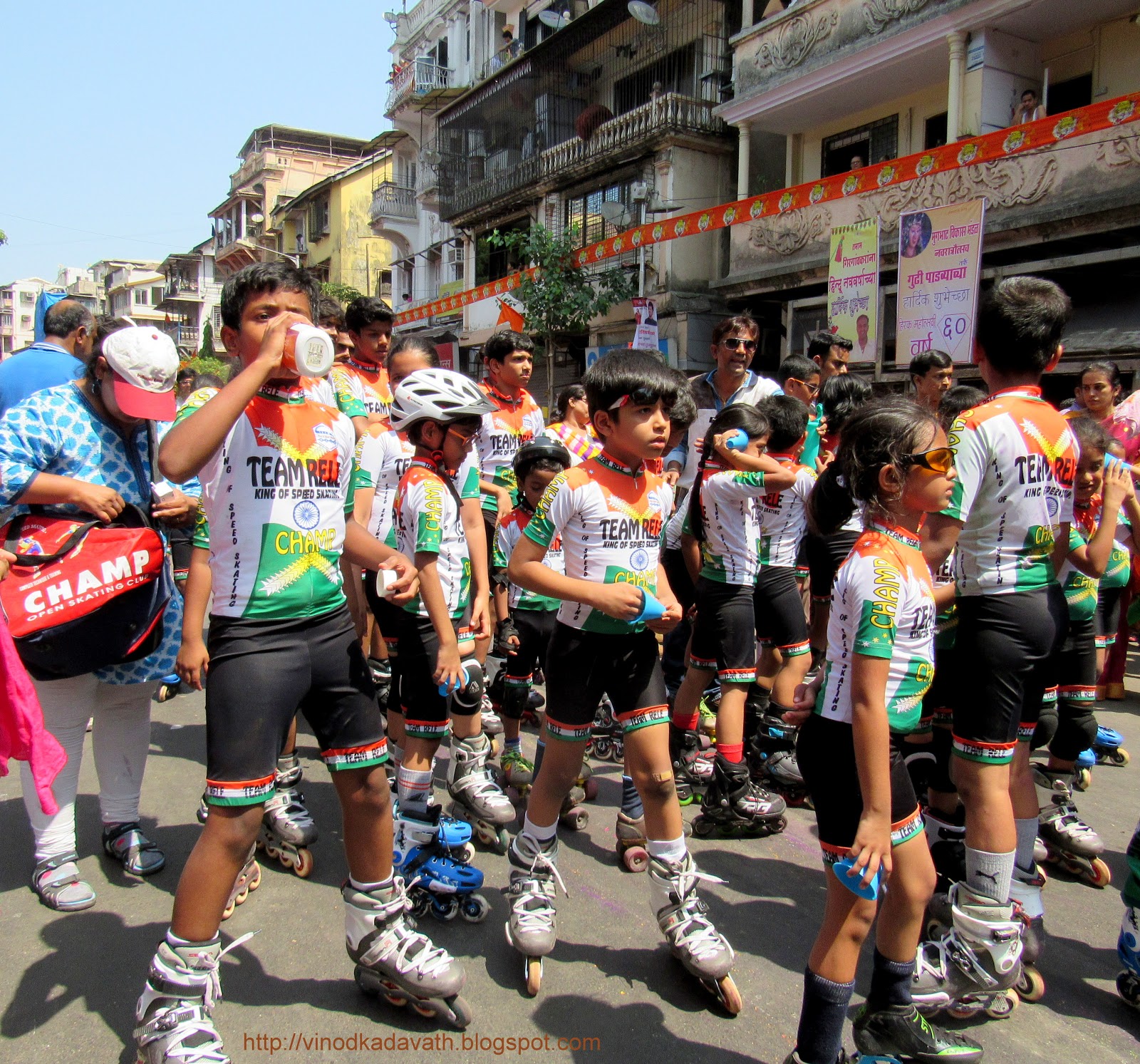
School children participate in a Shobha Yatra on the occasion of Gudi Padwa in Girgaon,Mumbai,Maharashtra 

Wednesday, November 11, 2015

Diwali : Mumbai When it Twinkles


This year, I was fortunate enough to be in Mumbai as it was the grand five-day holiday known as Diwali (Deepavali) also referred to as the ‘Festival of Lights’.

I walk through the streets of Vashi in Navi Mumbai, looking at the Diwali celebrations. Street markets is the best place to get the Diwali vibe. Shops were busy selling festive colored lights, jewelry, cloths and sweets.

Diwali is spiritually known to signify the triumph, or victory, of light over darkness. You can see streets shining brightly with millions of  festive colored lights. It was dark when I reached Chhatrapati Shivaji Terminus station. I was excited to see the special lightning given to the Chhatrapati Shivaji Terminus building on the occasion of Diwali.


And I headed to Marine Drive. The Marine Drive provided a stunning canvas for Diwali celebration. The pathways of Marine Drive was filled with people celebrating Diwali with fireworks and the area were completely filled with smoke.

It is believed that on this auspicious day, Lakshmi, the goddess of wealth and good fortune, roams about and visits the houses of people. Therefore, people arrange their homes and shops and decorate them lavishly to welcome the goddess. Rangoli is commonly used to decorate homes.


In the evening everyday, during Diwali, people light small lamps made of small earthen pots with a cotton wick and oil popularly known as diyas.


Often you can see diyas being placed outside the  homes.

During this festive season, people eat, shop and burst crackers a lot. Friends and relatives visit each other’s homes to exchange gifts and the sweets . Poojas  are organized at homes to spread the blessings of good fortune and prosperity for the New Year ahead. Often people organize pooja in their offices and sweets and gifts are distributed to employees. On this occasion, people wear traditional dresses.

I was very happy to have had the chance to spend this festival season  in Mumbai.

Tuesday, October 20, 2015

Durgotsav 2015 in Mumbai


Yet another festival I was waiting for after Ganpati festival. Durga Puja in Mumbai has all authentic spirit of celebration and splendor of the festival of Bengalis.  I was wandering through the streets of Mumbai to visit puja pandals....I saw Durga Pandal of Navi Mumbai Bengali Association at  Netaji Subhash Chandra Bose Sports Ground, Sector 1A, Vashi, Navi Mumbai.  It was amazing.

Pandal hopping is almost like a tradition when it comes to Durga Puja and Bengalis. The pandal was decorated lavishly with superior design and lightning.


The 16 feet-tall Durga idol was draped in an original Banarasi saree studded with ornaments made of seashells. Various gods were decorated beautifully. The walls were decorted with electric wires and bulbs.


The vast area of the compound were filled with stalls selling food, cloths etc etc. They also arranged musical and dance events during the Puja.  Durga Puja is definitely a festival to look out for especially those who love celebrations, mouth watering sweets, dance and music. 

Saturday, October 10, 2015

The Making of Goddess Durga in Mumbai

Two months back, I had an opportunity to visit a workshop in Parel, Mumbai  where  idols of Lord Ganesha were made . It  was a wonderful experience to see the making of the idols of the elephant-god. So I decided to visit a workshop making idols of  Goddess Durga, as well, at Dadar, Mumbai. 

Durga Puja festival marks the victory of Goddess Durga over the evil buffalo demon Mahishasura marking the triumph of good over evil.  Durga as a warrior goddess carry the most lethal weapons in her arms and rides on  a lion. 

Unfinished works-  at Dadar, Mumbai


When I entered the workshop,  I saw scores of idols in various stages of their making. There were finished and unfinished idols in the workshop. Most of the statues are made of clay, painted and later on decorated with sarees, hair, ornaments and weaponry.

 Artists gives finishing touches to an idol at a workshop in Dadar, Mumbai


There was a wide variety of idols varying from small to larger sizes, different shapes, vibrant colors and designs.


The idols are then transported in trucks or by cars to the places of worship. It was a great experience to see the creation of idols, which later I would  see in pandals

Sunday, September 27, 2015

Pune Ganesh Visarjan 2015


It was a much awaited trip to be a part of the Ganesh Visarjan procession at Pune and finally I got a chance to experience it.  Ganesh Festival in Pune was started with Bal Gangadhar Tilak  with five mancha ganapati's. This was a platform for community gathering, and  sharing their pains and gains with neighbours.

We started from Mumbai at around  06:40 am by Intercity Express and reached Pune at around 10.30 am. We had break-fast at a local joint and headed to Laxmi Road, the place of all processions .

A huge welcome rangoli was drawn at the centre. 


There were five “Manache” Ganapati mandals – Kasba Ganapati mandal, Tambadi Jogeshwari mandal, Guruji Talim mandal, Tulshibaug mandal and Kesriwada Trust mandal.

We were on the road to witness the charisma of five Manache Ganpatis. All eyes were looking into one direction only.


We reached just-in-time to wave goodbye to the first Ganapati.


The traditional ways of Dhols and attires of Navarri Sarees and Kurtas made the processions more colorful .


As the tradition goes, each Moorti has a Dhol Pathak (Group of members playing Dhols) leading the procession.  Each of them have their own way of attire.

Pune’s Iconic Dhol Pathak (Drum troupes)

Everyone were jumping with joy and dancing to the tunes of the dhols. With each beat, energy levels were going up.


The streets were filled with thousands of participants enjoying the drum beats.


Each of the Pathak, with their royalty and grandeur ,took us back to the history of Shivaji's times.


The traditional way of  all the five  grand processions were electric. 


As  the dhol beats were rising, energy levels were up and everyone waited with their heads and hearts on the road for the next Pathak to enter.


Some wore costumes that carried a message, banners, hoardings, placards etc etc . Some chose to use the procession as a platform to promote their message.


When the sun was high and energy low, we headed back to a local joint in the afternoon hours. After taking rest for some time, we headed to the river next to the bridge where Ganesh idols are ideally immersed. Pune Municipal Corporation had made arrangements to  immerse Lord Ganesh idols in water tanks rather than going in for the usual river immersions. But some of them preferred  the immersion into the river only.


As the light of the day dimmed, the colorful lights on the Ganesh Pandals became brighter.  Each pathak had a theme.


The crowd got thicker and the sounds got louder with Bollywood music. 

After another few hours of dancing, it was time to leave. Finally we had enjoyed the most awaiting festival in Pune- Ganesh Visarjan 2015.  

Sunday, September 06, 2015

A few glimpses of Dahi Handi 2015, Mumbai

"Handi"
Dahi Handi or Govinda is a popular festival celebrated across India and the best place to see this 'sport'  is in Mumbai, Maharashtra, India. It celebrates the legend of Lord Krishna stealing butter as a child. The festival activity involves the making of a human pyramid that would be climbed by  participants who would be known as 'Govindas' . The aim of the activity is to climb to the top and break the pot filled with a mixture of milk, dry fruits, ghee . It is celebrated on the second day of Janmashtami.

Here are some pictures from the celebrations in Mumbai.

3.30 pm:  Govindas start arriving 


4.30: There are several teams for trials. Cash and gifts are offered for Govinda troops to participate.
Govindas forming a human pyramid to break the Dahi Handi, in Mumbai
Little Govinda

9:00 pm : Below is a sequence of photographs I managed to take, demonstrating the pyramid going up and the Handi finally being reached by little Govinda.


Saturday, August 01, 2015

The Making of Ganesh Idols in Mumbai

This year Ganeshotsav will begin on September 17 and Anant chaturdashi will be celebrated on September 27.

I was surprised to see different types of Ganesha Idols during Ganesh Visarjan in Vashi  last year. It's quite natural to wonder about how they're made . This year I decided to visit some Ganesh Idols workshops and understand the entire process.   

Near Parel, I visited the workshop of Kalasagar Arts.  When I entered the workshop,  I saw scores of idols in various stages of their making. Some are complete and they all kept in rows. 


There was wide variety of idols varying from small to larger sizes, different shapes, vibrant colors and designs. There were unfinished Ganesha Idols and are still being shaped out of plaster .

Artists busy making Ganesh idols at a workshop in Parel, Mumbai

All around the workshop, artisans were busy with the making the statue of the Lord. Some of them were casting  face, hands, feet, stomach and additional accessories while some others assembling these various parts to form a single idol.  


An artisan putting the final touches on an idol of Lord Ganesh at a workshop in Parel, Mumbai

Near to the entrance of the workshop, idols of different sizes and designs kept, row upon row, awaiting order.


It was just mind blowing to see many idols in all shapes, sizes, colors in one place and I loved this workshop walk.

Location: Parel, Central Mumbai.
Nearest Railway Station: Walking distance from Parel station.
Visiting time: It's open around the clock.

Friday, November 07, 2014

Durgadi Fort When it Twinkles


After a busy day of work, I took a cab from Ghansoli to reach the Hotel. As the cab arrived at the hotel, I hurried inside and after  quickly freshening myself  rushed to Kopar Khairane station on my way to Kalyan. Upon reaching Kalyan, I walked around to find a place to eat. The sidewalks were filled with vendors selling cloths, sweets and  everything you could think of. After having snacks and tea, I waited there for my group members to arrive.

We were on  our way to Durgadi Fort -  Kalyan city's most adored historical monument.  There is a temple of Durgadi Devi on the fort. The  fort is named after Goddess  Durgadi Devi.

Every year on Tripurari Purnima (also known as Kartik Purnima), the Durgadi Fort is illuminated with hundreds of brightly-lit earthen lamps ('Diya') as a symbolic welcome to the Gods as they descend on Earth. This happens to be 15 days after Diwali.  The fest is also known as Dev-Deepavali ( Deepavali of Gods).

Entrance of Devi Durga's Temple on Durgadi Fort.

History says that Shivaji had built this fort near the Ulhas river and used it as a dock to build boats.The top of the entrance gate is colored orange, to commemorate the orange used in the flag during Shivaji’s regime. The entrance and side walks were filled with people.  People had come from everywhere. With our cameras, we scurried along the busy sidewalks. The whole area was illuminated with diyas. It was  interesting, so exciting.

The illuminated Durgadi Fort
After crossing the entrance a tar road that goes to the top of Durgadi fort. Then a well laid stairs that going upto the temple. You can see a Ganesh Mandir before reaching the temple.

In the day time,  you will get a amazing view of Retibunder, Kalyan-Bhiwandi Bridge and Ganesh Ghat from the top of the fort.

An ancient seal (written in Sanskrit) inscribed on front saffron colored wall of goddess Durga's temple

The temple itself is a small structure with a dome. It is said that, in 1876, the original Durga idol from the temple was stolen, and new idol was placed in 1974 as part of the rennovation of the Durga temple and the fort. The old idol is placed beside the new idol. The idol is four-armed, three and half feet in height, with a lion resting at its back.

After walking around for about two hours, we finally found our way back to Kalyan station.


Monday, September 08, 2014

Ganesh festival, visarjan day in Vashi, Navi Mumbai 2014


Vinayaka Chaturthi or Ganesh Chaturthi celebrations end with the Visarjan (immersion ) of clay Ganapati idol in sea. In Mumbai, it’s a day of long processions filled with pomp and splendour when the Ganesh idols are immersed in the sea there. I walk through the streets of Vashi in Navi Mumbai watching Ganpati immersion procession. Chants of  Ganpati Bappa Morya......... Mangal Murthy Morya .... reverberated through the air. 

The streets are filled with loud music, drumming, dancing, and fire crackers.

  
The Ganesh idols come in all shapes and sizes. Each one tells a story.


The Idols taken in cars, trucks or carried in hands for the immersion.


Leading the Ganesh idol to the water.

                                          
Immersion of Ganesha idols continues late in the night. Finally He departs to His Heavenly abode...  

‘Do come back early next year!